Designing a Unified Customer Journey That Reduced Experience Fragmentation Across Digital, Retail, and Service
Reframing a Premium Brand Experience for Dyson
Role: Customer Experience Designer
Dyson & Wunderman WPP
Customer Experience, Brand Startegy &
User Reasearch
Commerical Retail
3 Months
Challenge
Dyson is widely recognised for innovation, engineering excellence, and premium quality. However, the intent of this project was to examine whether that strength was still translating into a clear, human-centred experience for customers.
The challenge was not a lack of technology or ambition, but a growing distance between the brand and its users.
Key tensions emerged early:
Dyson could not clearly articulate who its customers were, despite serving a large and diverse audience.
Products, services, web, app, and retail operated as parallel systems rather than a cohesive experience.
Customer feedback was fragmented across layers of services, limiting learning and responsiveness.
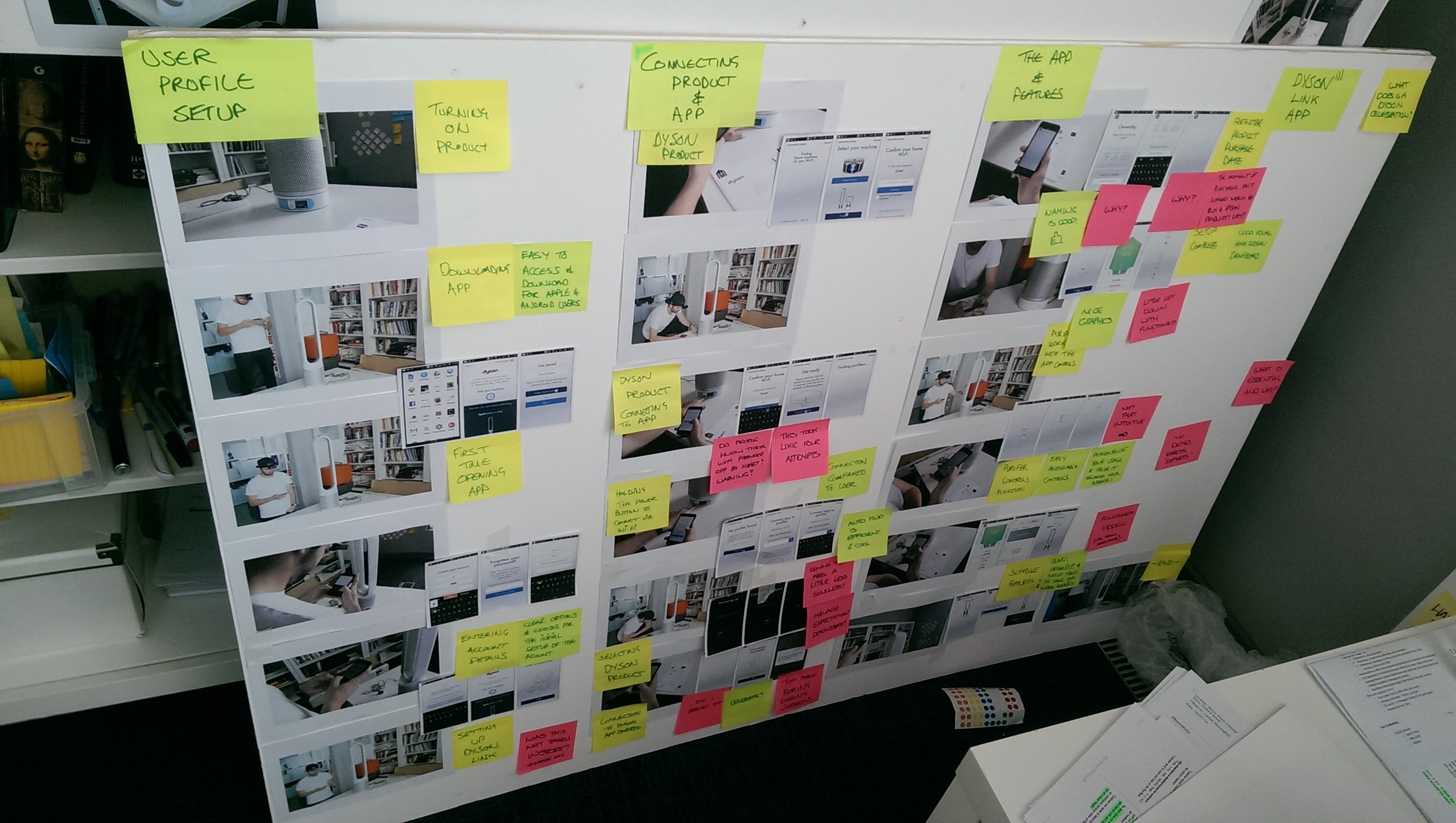
Digital experiences prioritised feature depth over usability, leading to confusion and decision fatigue.
Retail spaces echoed Apple Store conventions, diluting Dyson’s own brand identity rather than reinforcing it.
The risk was a premium brand that felt impressive, but impersonal.
The Outcome
The final output was not a single design solution, but a coherent experience strategy that identified deployable opportunities across:
Core product development.
Digital UX/UI improvements (web and app).
Service and maintenance design.
Brand communication and tone.
Change management and organisational alignment.
Each opportunity was directly tied back to observed customer needs and behaviours.
Results
Pitch success: Dyson selected Wunderman’s proposal over competing agencies.
Client confidence: The walkthrough established a shared understanding of customer experience challenges and opportunities.
Long-term value: Dyson became an active, ongoing client of Wunderman WPP.
Strategic shift: The work reframed Dyson’s challenge from “adding innovation” to strengthening human connection through clarity and coherence.

Process
I approached the work by focusing on understanding before proposing.
Grounding the work in real behaviour
We conducted ethnographic research through in-field observations, customer participation, interviews, and research probe kits. The goal was to observe how people actually lived with Dyson products and understand what they valued, what frustrated them, and where expectations broke down.
Making sense of complexity
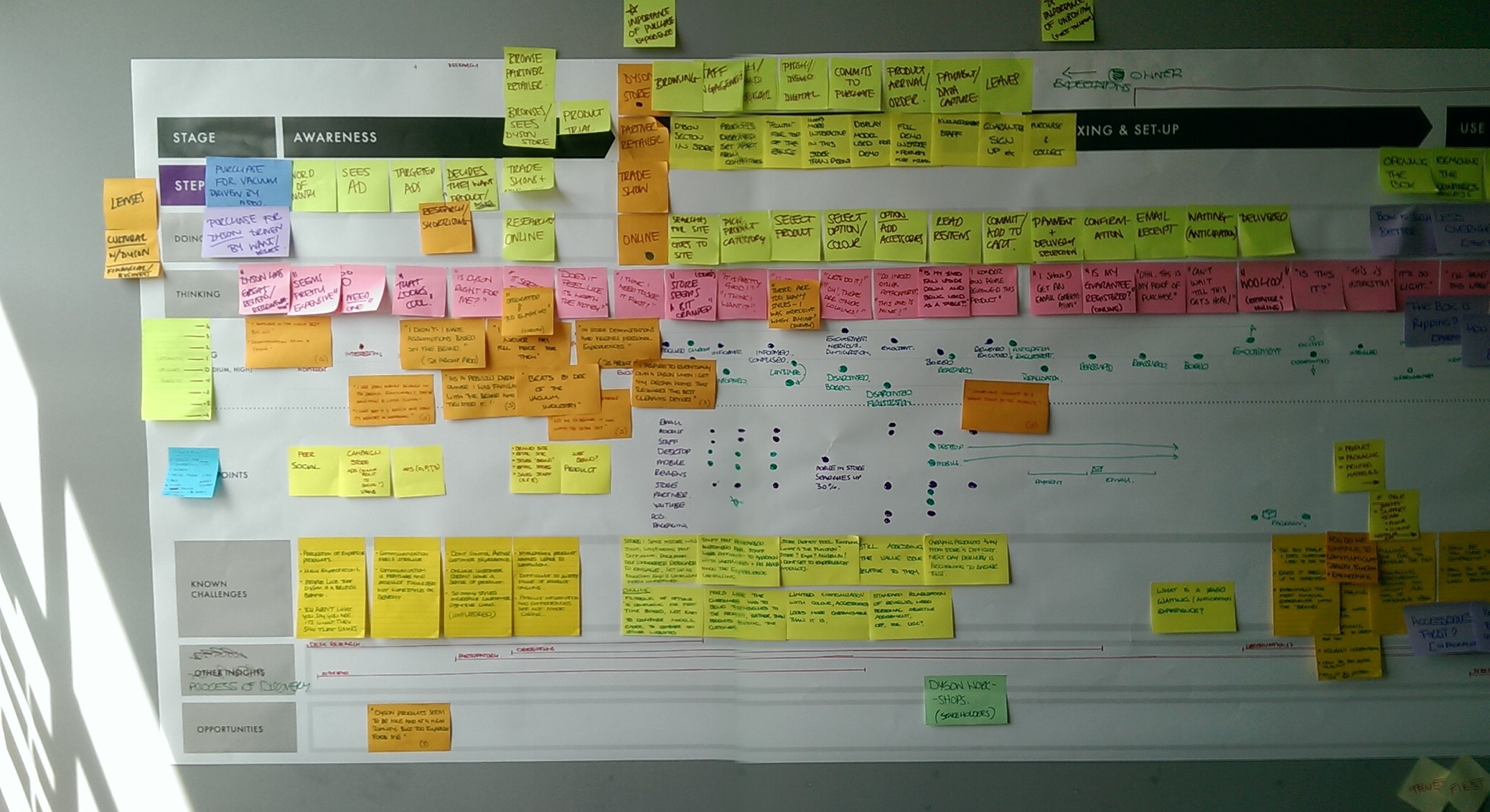
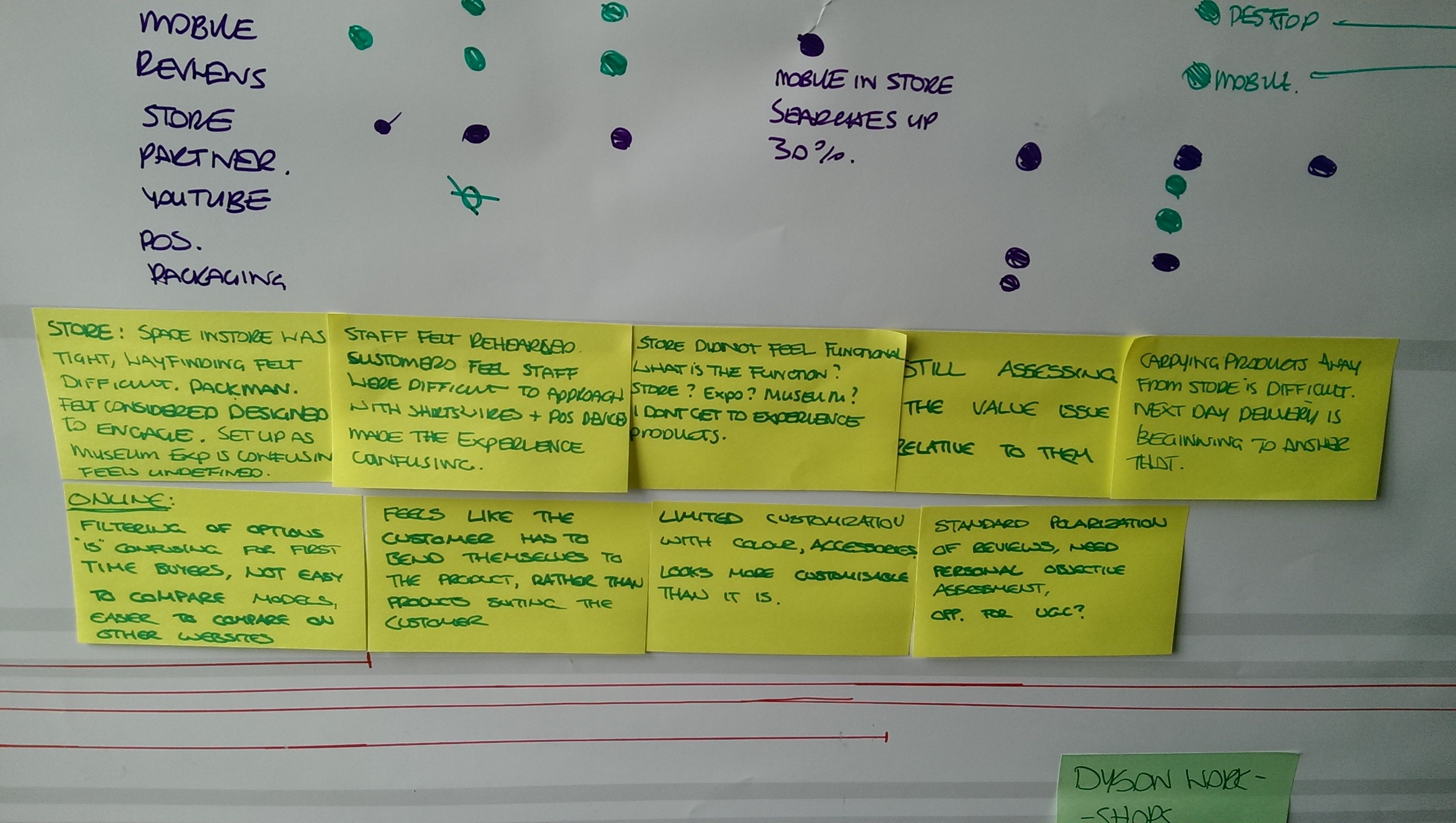
Insights were synthesised into a large-scale customer experience map, spanning the full lifecycle from discovery, purchase, daily use, maintenance, and service. The map captured not only actions, but thoughts, emotions, and unmet needs at each stage.
Revealing systemic gaps
This process surfaced clear patterns:
Choice paralysis during product selection.
Overly dense digital flows for simple tasks.
Unclear service and maintenance pathways.
Missed opportunities to build long-term relationships post-purchase.
Rather than treating these as isolated UX issues, we framed them as signals of deeper system misalignment.
Translating insight into opportunity
My role included shaping a clear narrative called Our Dyson Story: Connecting with the Customer. This helped guide stakeholders through the research and reframed the customer experience as a strategic lever, beyond a cosmetic redesign.
Conclusion
What worked well
Deep ethnographic research grounded the work in reality rather than assumption.
A clear experience narrative helped align diverse stakeholders.
Treating brand, product, and service as one system created credibility and trust.
What could have been improved
More direct access to internal Dyson service teams could have strengthened operational insights.
Quantitative validation at later stages would have supported prioritisation.
Takeaway
This project reinforced that strong brands are sustained not by novelty, but by how well they listen, simplify, and respond to people over time.